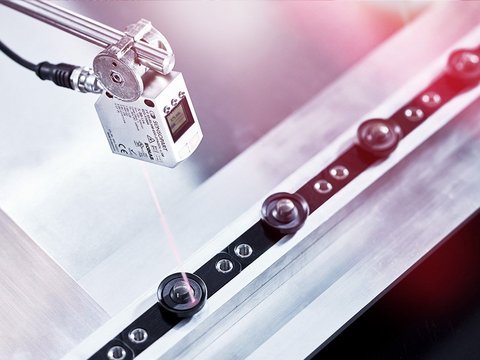
Speed, precision and reliability are what really matter in the intralogistics sector. Automated processes are of decisive importance when you need to control material flows with efficiency, use resources optimally, and successfully withstand rising competitive pressures.
As a leading sensor manufacturer and expert for vision sensors, SensoPart offers powerful solutions that enable smooth processes and minimize error sources. Whether for warehousing, in-house transport, or automated product picking: Our intelligent technologies establish the prerequisites for sustainable and scalable automation in the field of intralogistics.
- Benefits of automating your intralogistics with SensoPart
- Application examples in intralogistics briefly explained
- Wafer box handling in the semiconductor industry
- Robot-assisted fueling
- Moving & placing objects
- CNC machine tending
- Automation in goods receipt
- Packaging & shipping
- Maximizing storage capacity utilization
- Determining the AGV's position
- Products: the right solution for your application
Automate intralogistics with SensoPart: Your advantages
Whether you're using optical or vision sensors, by implementing SensoPart's intelligent sensor solutions, you'll gain key advantages in the automation of your intralogistics processes.
- Increased process reliability: Reliable sensor detection reduces error sources and enhances the stability of your processes.
- Maximum efficiency: Greater throughput rates, fewer downtimes and optimal use of resources.
- Scalability: Adaptable solutions for individualized intralogistics requirements – from warehouse technology to picking and order fulfillment.
- Reduced costs: Low operating costs through optimized utilization of resources.
- User-friendliness: Intuitive operation and easy handling thanks to intelligent, partly AI-powered solutions.

Customized automation solutions for your intralogistics needs
Every phase of intralogistics – from goods receiving to storage and transport and on to product picking – makes special demands of precision, efficiency, and flexibility. SensoPart offers you a broad portfolio of sensors for each need that have been specially developed for automation processes and seamless integration in existing conveyor systems.
With powerful vision sensors, such as the VISOR® Robotic, VISOR® Code Reader or the optical distance sensors (e.g., the FT 25-RLHP series), position determination, object detection and quality control can be implemented reliably and efficiently. We have listed a few application examples for you here.


Wafer box handling in the semiconductor industry
When handling wafer boxes, such as FOUPs, the boxes are often still carried manually from one station to another in many production facilities. This makes production dependent on personnel, increases the risk of contamination, and is hardly scalable given the shortage of skilled workers. Mobile robots on AGVs can provide relief here, however, their position can often deviate by several centimeters – with the danger that extremely valuable, full wafer boxes (€ 10,000 to € 100,000 and more) could be missed or damaged.
The VISOR® Robotic with target mark compensates these deviations: It supplies precise 3D gripping positions from 2D images and can be quickly calibrated or recalibrated across different robots. This reduces the effort required for integration, increases process reliability, and minimizes downtimes.


Robot-assisted fueling for driverless transport systems
Automated guided vehicle systems (AGV) take over in-house transport tasks fully automatically – with precision, reliability, and no lost time. They offer an even greater advantage when automated guided vehicle systems are refueled using robotic technology.
SensoPart offers robust automation solutions for this task: Our VISOR® Robotic, in combination with Target Mark 3D technology, ensures that the vehicle's position is detected with precision – with no complex image processing at all, using only a coded marker.
Moving and placing objects
In a shipping warehouse or production facility, speed and precision are essential. Complex tasks such as moving and placing different objects or recognizing and sorting items require reliable solutions.
Our VISOR® Robotic in combination with Target Mark 3D enables exact and reliable gripping point determination, even in unfavorable illumination conditions or with complex object shapes. Its advantages are particularly evident when handling wafer boxes, where the orientation of the items varies and flexible object detection is crucial. The vision sensor minimizes error rates in intralogistics and significantly increases the sorting speed. And the best part: The VISOR® is easy to configure and adapt to changing requirements.

Are you interested in our products?
Our experts will be happy to advise you! You can reach us by phone at
+49 7673 8210 or use our contact form.
CNC machine tending
In CNC machine tending, unmachined parts must be reliably loaded into lathes and milling machines, and the appropriate tools must be changed regularly – tasks for which it is becoming increasingly difficult to find qualified personnel. Consequently, many companies rely on mobile robotic arms mounted on AGVs, although their position often deviates by several centimeters. This can lead to incorrect gripping and damage to raw materials or tools.
The VISOR® Robotic vision sensor with target mark compensates these deviations: It determines precise 3D gripping positions from 2D image data regardless of the AGV position and can be calibrated easily across different robots. This reduces the effort required for integration and minimizes downtimes.

The flexible use of mobile robots requires the exact determination of their position.

Automation in goods receipt
How smoothly your downstream intralogistics processes operate is determined already in the goods receipt stage. This is why error-free identification of goods, containers and pallets is indispensable. With our vision sensors from the VISOR® Object series, you get reliable detection of barcodes, data-matrix codes and object contours at high speed – even with changing packaging or in turbulent environments. This ensures that each unit is correctly recorded, categorized, and assigned to the correct storage location or process step. This saves time, eliminates the need for manual follow-up work, and ensures transparency from the very beginning.
Reliably automate packaging and shipping
End-of-line logistics is all about preparing finished goods for shipment quickly, reliably, and accurately. SensoPart's sensor solutions support automated packaging processes through reliable object detection, volume measurement, and completeness inspections. Our vision sensors can detect, for example, whether shipping containers are properly sealed or fully loaded – even at high speeds. This helps you avoid mis-shipments, improves packing quality, and ensures consistently high process reliability all the way to the final station.
BlueLight sensors, such as the FT 55 BH, are also used to detect shipping pallets – this ensures efficient control of downstream steps, such as wrapping the pallet in foil.


Detecting vacant locations & maximizing storage capacity utilization
In warehouses that are used dynamically, it must be clearly evident at all times which shelf locations are vacant or occupied – especially in the case of deep or hard-to-see shelf bays. Optical sensors reliably detect the occupancy status of individual storage locations and provide precise feedback to the warehouse management system. This enables automated space allocation, prevents incorrect storage, and optimizes the utilization of your warehouse infrastructure.
Especially in automated multi-depth shelf systems, continuous sensor monitoring ensures smooth operations and significantly reduces downtime. This allows you to maintain a clear overview at all times and lay the groundwork for fully digitized warehouse processes.
Determining the AGV's position
In many manufacturing processes, components must be reliably transported from position A to B so that subsequent process steps can proceed without interruption. Due to a shortage of skilled workers and rising costs, many companies are turning to AGVs and AMRs. However, their stopping position often deviates by several centimeters from the target position, which in turn can cause robotic arms to miss parts or damage them with the gripper.
The VISOR® Robotic with target mark compensates these deviations: It generates precise 3D gripping positions from 2D image data and can be easily calibrated and recalibrated across all robots. This reduces the effort required for integration and minimizes downtimes.

Choose the right solution for your requirements
Every intralogistics task comes with its own technical requirements – whether it involves precise warehouse positioning, reliable detection of load carriers, or secure gripping during order picking. Our sensors designed specially for these needs allow you to implement your automation strategy in a way that remains future-proof.


All application examples from the intralogistics sector
The following application examples show you the deployment possibilities for our products in practice.
Filter application examples
15 Application examples match your search criteria

CNC machine tending
When processing metal parts in lathes or milling machines, the raw materials must be clamped in the machine before the machining. In addition, each machine requires the right tool for the respective machining operation, and it must be changed regularly depending on the material and the end product. These processes are among the central tasks in machining production and require a high degree of precision and repeatability. Trained specialist personnel are required for clamping the workpieces and changing tools.
Comparing Plain Text and DMC-Codes
In modern production facilities, where traceability and quality control are essential, reading OCR and DMC codes on components plays a key role. These codes are used not only for identification, but also to ensure complete traceability of products and components throughout complex manufacturing processes. A reliable vision system must not only recognize OCR and DMC codes, but also compare them against each other.

Detection of packages on conveyor belts
Thousands of parcels are transported on conveyor belts in logistics every day. They must be sorted, diverted, and dispatched. For a smooth process at loading and transfer points, the presence of the packages should be checked with an optical detection system. The front edge of the packages should be reliably detected.
Detection of pallets with BlueLight sensors
The detection of transport pallets plays a central role in many intralogistics processes. Sensors must be able to detect the pallets quickly and consistently to ensure they are ready for subsequent work steps, such as wrapping the pallets in film.

Effortless Traceability: Displaying code contents, texts,
In modern manufacturing, the need for seamless component traceability (Track-and-Trace) continues to grow. Data Matrix Codes (DMCs) have emerged as one of the most reliable methods for identification and traceability. The goal is to scan the Data Matrix Code on each component, guaranteeing precise product processing and flawless serial number management.

Fast, Easy Code Reading in Just a Few Clicks - No Expertise Needed
Every day, countless packages are shipped around the world. To ensure each one can be tracked reliably, shipping labels must be read accurately, often containing barcodes, QR codes, or DataMatrix codes. A vision sensor is used to automatically identify and decode these labels. However, proper setup is required before the sensor can perform this task effectively, and this setup process is often the first obstacle.

Localization of the AGV/AMR position for various applications
In modern production environments, objects must be transported reliably and efficiently from position A to position B to enable the next processing steps. One way to meet these logistical challenges is to use automated guided vehicle systems (AGVs) or autonomous mobile robots (AMRs). Precise localization and navigation of these mobile transport robots is crucial for a smooth material flow – especially if they are intended to support automated assembly, loading or transfer processes.

Palletisation of packaging
Once packed, the end products must be stacked on transport pallets. However, the position of the boxes can fluctuate as they arrive, and their density on the conveyor belt can also change due to different cycle times.

Position determination of load carriers for autonomous storage and retrieval Cover Home Applications & Industries Applications The task Driverless transport systems (AGV) or automated guided vehicles (AGV) enable flexible design of logistics processes. In
Driverless transport systems (AGV) or automated guided vehicles (AGV) enable flexible design of logistics processes. In order for the AGV to pick up the load carrier at the right place and then set it down, it must be provided with a trigger signal using an optical sensor. The sensor should detect the load carrier at a specific position in the flow rack.

Reliable Completeness Check of Storage Boxes
Storage boxes are essential for efficient transport and storage in automated systems. Before shipping, it’s critical to ensure that each box is fully loaded. This prevents consumer complaints and ensures consistently high process quality. A sensor is used to perform this completeness check.

Reliable Presence Detection of Objects on the Conveyor Belt
Millions of objects move along conveyor belts every day, advancing to the next processing step. Before downstream operations can begin, it must first be confirmed that an object is present on the workpiece carrier. A sensor is needed to reliably perform this presence check and keep production lines running smoothly.

Robot-assisted refueling of AGVs (with Target Mark 3D)
Utilizing robotic assistance, AGVs can be automatically refueled or recharged. The robot will dock the charging system or fuel port to the AGV, streamlining the process.

Robotic assembly on AGVs (with Target Mark 3D)
A robot is tasked with performing various processing steps on a battery pack, which is transported into the processing cell by an AGV

VISOR® Makes Component Positions Visible
A robot is tasked with picking components from a flexible feeding platform. The position of the objects may vary. A vision sensor can identify and relay the exact position of the part to the robot.

Wafer box handling in the semiconductor industry
In modern semiconductor factories (fabs), wafer boxes, such as front-opening shipping boxes (FOSBs) or front-opening universal pods (FOUPs), are currently still often transported manually from station to station. These boxes are used for the safe transportation and temporary storage of sensitive wafers during the production process and must be handled with extreme care.